
 Back
Building Africa's Biotechnology Future Through Proximity, Not Dependency
By:Dr. Menghis Bairu
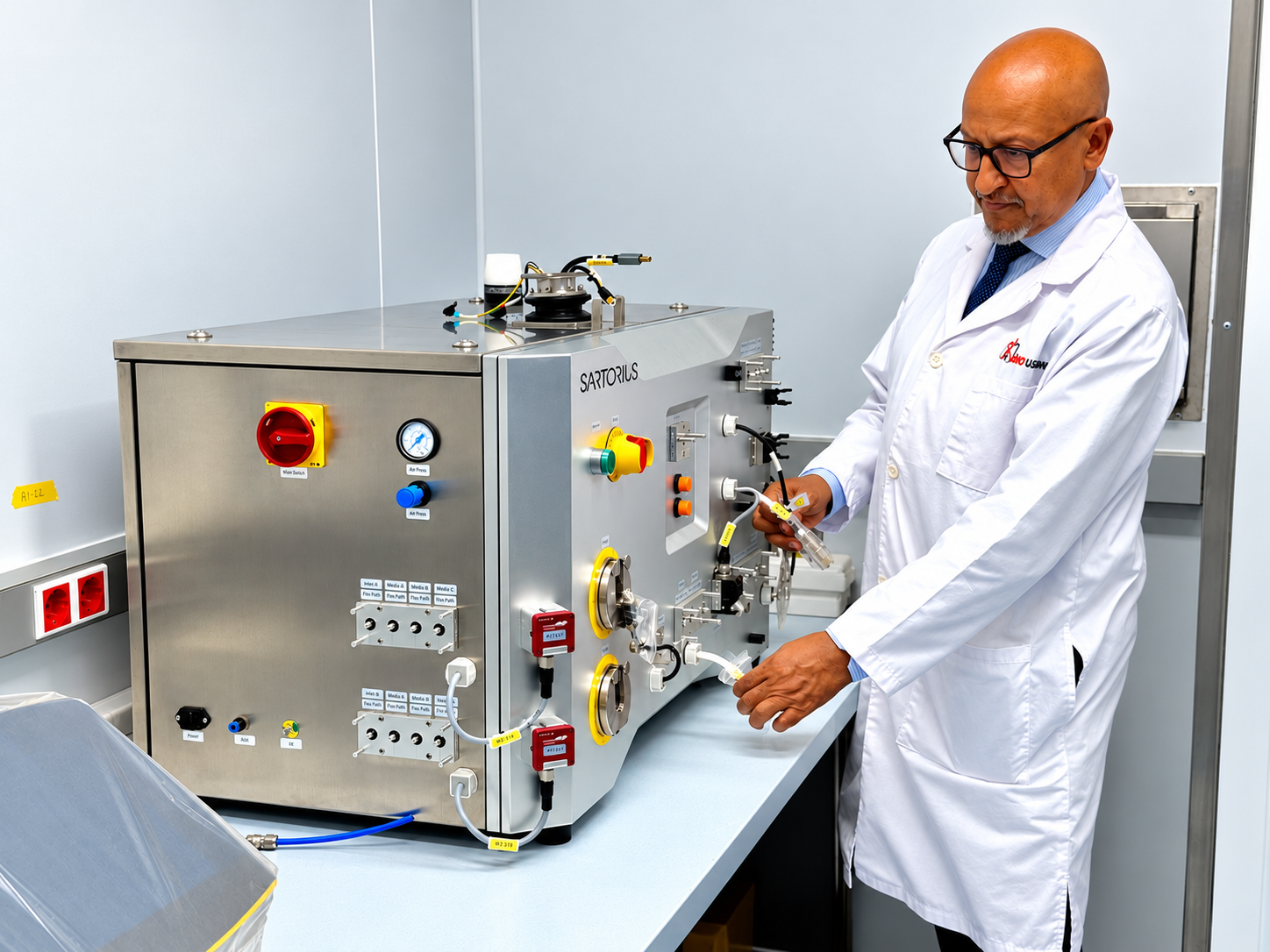 Dr. Menghis Bairu, CEO and President of Bio Usawa, inspects a piece of equipment inside the near-completion Bio Usawa modular manufacturing facility in Kigali
As African health authorities strengthen preparedness against Ebola and other emerging health threats, a persistent challenge remains. The continent is heavily dependent on imported medicines, vaccines, diagnostics, and advanced therapies.
Recent outbreaks have underscored the risks of relying on supply chains located thousands of kilometers away, particularly when urgent access to critical health technologies can determine how effectively an outbreak is contained.
The question is not whether Africa should engage with global health innovation. It is whether African countries can build the capacity to contribute to it, produce more of the health technologies they need, and respond more quickly when new threats emerge.
Biotechnology is increasingly becoming a strategic priority for Africa. The solution, however, is not simply to build more factories. It is to build ecosystems.
The future of African biotechnology depends on proximity: bringing research, manufacturing, technology transfer, talent development, clinical partnerships, and commercialization closer to the communities they serve. Proximity can accelerate innovation, strengthen local expertise, support faster responses to public health threats, and keep more value creation within African economies.
For decades, many African countries have imported the vast majority of the health technologies they consume. That model leaves the continent vulnerable to supply disruptions, geopolitical pressures, and long delays during health emergencies. Building regional biotechnology capacity is not about isolation or turning away from international collaboration. It is about resilience: ensuring that global partnerships are matched by stronger capabilities on the continent.
This requires more than physical infrastructure. Biotechnology ecosystems depend on skilled scientists and technicians, effective regulators, research institutions, clinical partnerships, reliable supply chains, and patient investment. They also need pathways to move scientific knowledge into products that can be manufactured at scale and made accessible to patients. Without these connections, a factory risks remaining an isolated asset rather than part of a sustainable industrial base. For complex biologic medicines, the knowledge required to manufacture consistently and meet quality standards is as important as the facility itself.
Proximity matters because capability grows through practice. When research, production, and clinical experience are connected locally, expertise can be developed and retained, technology transfer can become more meaningful, and institutions can build relationships over time. Regional hubs could also complement one another, sharing knowledge and capacity rather than requiring every country to develop every capability independently.
This is where Africa’s diaspora can play a more strategic role. Across the world, Africans are leading pharmaceutical companies, biotechnology firms, research laboratories, investment funds, and healthcare institutions. Their contribution can extend beyond remittances to include capital, technical expertise, commercial networks, and long-term partnerships. Mobilizing these resources can help connect global experience with Africa’s priorities and opportunities.
In Rwanda, one such effort is taking shape. Bio Usawa, an African diaspora-financed biotechnology initiative, is establishing an end-to-end monoclonal antibody research, development, and manufacturing facility in the Kigali Special Economic Zone. Built in less than a year, the facility is intended as a first step towards a broader network of regional biotechnology hubs across Africa, supporting advanced research, biomanufacturing, workforce development, and technology transfer closer to the populations these capabilities are meant to serve.
The opportunity is larger than any single company, facility, or country. It is the chance to build the foundations of a continental biotechnology economy: one in which African scientists develop solutions, African manufacturers produce them, African healthcare systems deploy them, and African patients benefit from them.
Realizing this vision will require governments, regulators, universities, development partners, private investors, and the diaspora to work together. It will require clear and consistent regulatory pathways, sustained investment in talent and research, and patient capital prepared to support long-term capability rather than quick returns. No single institution can build this ecosystem alone.
The conversation about African biotechnology is often framed around future potential. But the work of building capacity is already beginning. The task now is to connect and scale these efforts, so that Africa’s response to future health challenges is defined less by dependency and more by proximity, capability, and self-determination.
The author is the co-founder, CEO and President of Bio Usawa
See all
Other News
Building Africa's Biologics Future: A Hi…
For generations, many of the world’s most advanced biologic medicines have been developed and manufactured far from Africa. But what if Africa could bu…
October 2026Bio Usawa Celebrates Board Member, Dr. A…
Bio Usawa is proud to celebrate Dr. Aida Habtezion, a member of our Board of Directors, on her new role as a Global Health Faculty Fellow at the Stanfor…
October 2026Bio Usawa Takes Major Step Toward Buildi…
Bio Usawa Biotechnology today announced the launch of Bio Usawa Biotech Botswana (Pty) Ltd, marking an important milestone in the company’s mission to b…
October 2026